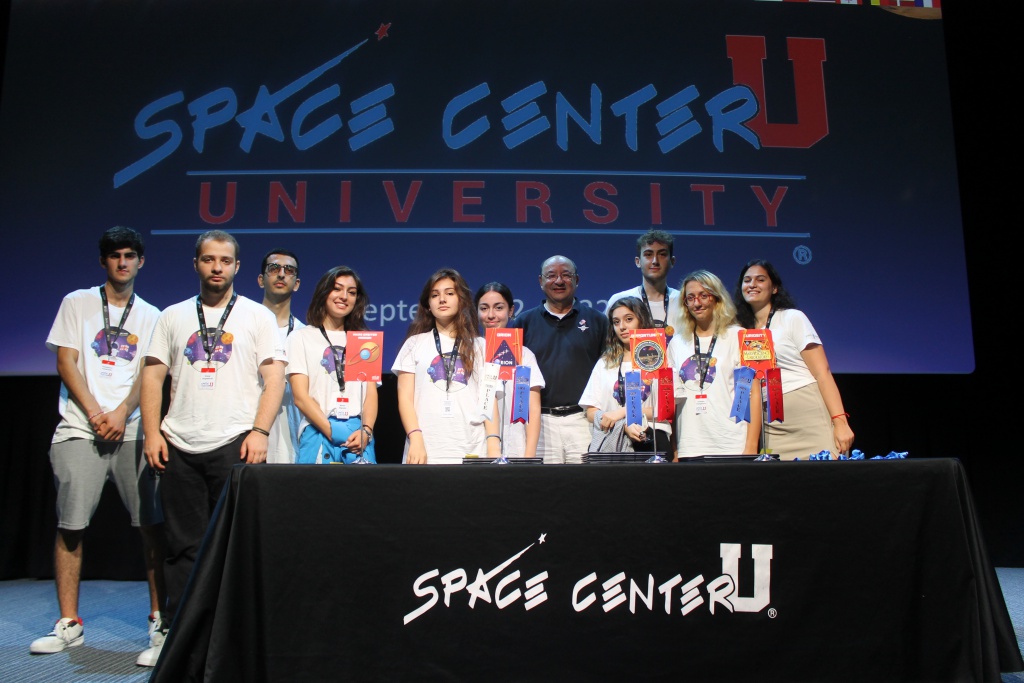
The members of the winning teams of the Millennium Innovation Award, "Medeori" and "Elves", participated in the training program of the NASA Space Center University in the USA.
During one week, at the official visitor center of the Johnson Space Center in Houston, young inventors learned about NASA's activities, met NASA astronauts and scientists, and actively participated in the creation of various prototypes.
"Due to the pandemic, the winning teams waited for two years to go to NASA. With funding and support from the US Embassy, this year we were able to send the winning teams, totaling ten participants, to the US to participate in a unique NASA program, where they had the opportunity to learn in detail about NASA's activities and receive information directly from NASA scientists and employees. The Millennium Foundation continues to organize the Millennium Innovation Award in order to give more young people this unique opportunity," - said Magda Magradze, CEO of the Millennium Foundation.
Within the framework of the program, the participants visited the most interesting and historical places of the NASA center, namely the control center of the Apollo 11 mission. The Christopher Craft Mission Control Center is where the NASA team monitored the Apollo 11 journey to the moon. The participants also visited the astronaut training center, various laboratories and simulation rooms.
The culmination of the week was a meeting with former NASA astronaut Mark Polansky. Mark Polansky served 13.5 years in the US Air Force and became a NASA astronaut in 1996. He has made three journeys in space, where he spent a total of 1000 hours. Mark Polanski told the participants about his career, his path to become a NASA astronaut, what was the most difficult thing to overcome in space and what he was most afraid of.
The participants saw a Saturn V rocket that has been fully restored and consists of parts and equipment certified for real flight. The participants tested several training exercise for astronauts and performed several tasks underwater to feel weightlessness simulation.
The participants met with Professor Tess Caswell, who told the participants about the Human Exploration Research Analog (HERA) program, which is an analogue of the space habitat created on Earth. Professor Caswell lived with three colleagues on HERA for a month and participated in a study that examines the psychological state of astronauts in confined and stressful situations.
During the week, young inventors worked on various tasks, in particular they created a mini-model of a space rocket and a habitat for astronauts on Mars, and built rover robot and worked on its coding and programming.
"This one week was a unique experience that we never imagined we would get. During this one week we learned a lot and had direct communication with many smart and exemplary people. We met astronauts and people whose names are not known during the rocket's launch, but are instrumental for successful launch. We recommend everyone to participate in the Millennium Innovation Award, to form a team and meet new people, develop yourself and your ideas, and who knows, maybe you'll find yourself here tomorrow "- said the participants.
At the end of the week, the winners of the Millennium Innovation Award were ceremoniously presented with program completion certificates and awards.
The Millennium Innovation Award has been implemented since 2014 with the support of the U.S. Embassy in Georgia and aims to promote innovation and STEM education among Georgian youth. Teams participating in the competition must present their projects in the fields of Science, Technology Engineering and Math (STEM), in areas such as: space and aviation, robotics, mobile technologies and applications, environment, Health care and nutrition. About 2,500 students have participated in the competition so far.